Words and pictures by Tim Forssman.
The White Lady of The BrandBerg, Damaraland, Namibia
Ihe White Lady has been shrouded in controversy since she was first discovered in the mid-20th century, when the renowned Abbe Henri Breuil, a French Catholic priest and archaeologist, reported on the site
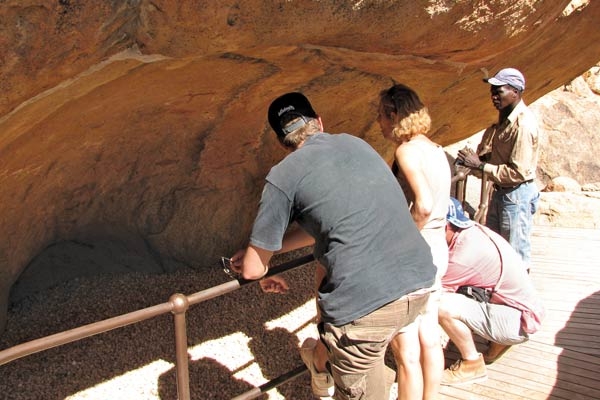
 His findings sent the small, fairly innocuous image into the history books. He called it the White Lady, and argued that it was a princess from southern Europe, based on similarities between it and paintings in Crete. He mentioned specifically the adornments held by the White Lady, her colouration and her central position in the panel. His views, although held for many years, are complete rubbish.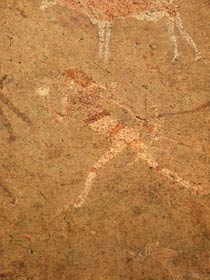
Many people all over the world still have wild and absurd beliefs about our prehistory. Some believe the pyramids in Egypt were built by aliens, denying Egyptians their own history. Others feel that the first civilisation in Sumeria (in modern day Iraq) was due to alien gods giving humans advanced technology. Of course, there is no evidence for this, and those who punt these views usually dismiss respected theories as attempts by archaeologists to brainwash the public. Quite why we would want to do so, has yet to be explained.
In southern Africa we have our fair share of ‘alien’ theories, such as there having been ancient astronomical observatories, and even Indian worship centres – the Iron Age stone circles found over much of southern Africa. While these theories spark one’s imagination, they are mostly fantastical, and their proponents struggle to string together any decent evidence, if there is any attempt to do so at all. There have also been a great many theories born out of ignorance; one being that of Great Zimbabwe, initially thought to have been Queen Sheba’s African kingdom built by King Solomon. It is in this boat that the White Lady finds herself.
It was thought, and still is, that Phoenicians settled in southern Africa. While there are reports of their extensive travels, there is no actual evidence – genetically or culturally – of their ever arriving here. Many of these theories were started because of the racist views of local communities, which unfortunately were perpetuated and are still held in modern society – denying southern Africans their history and heritage.
But, you might ask, what evidence is there that proves that they are not of, or painted by, foreigners? Quite simply, tons. In southern Namibia there’s a cave named after man’s first mission to the moon, Apollo 11. It was excavated in 1969 by Eric Wendt who, in his excavations, found a piece of rock with a painted kudu on it. The rock had fallen from the roof and been buried. By dating the sand above and below the art, he found that it had fallen about 27 000 years ago! The style of the image is similar to the art found throughout southern Africa which has been strongly linked to Bushman artists, and predates any so-called Phoenician occupation.
Other evidence includes accounts of Bushman artists both painting and mixing paints from the 1800s. There is also, of course, the deep link between Bushman beliefs and the meaning of rock art. In Bushman culture there is one main ritual called the trance dance. This ritual helps regulate and harmonise their society. It is usually begun in the evening by women clapping and singing songs about animals, which include eland, gemsbok and giraffe. Men eventually join in, and dance around the women and the fire. Over time, the men begin entering the spirit world. Here they heal the sick, control game, travel to neighbouring camps, ward off evil spirits and make rain. Those who do this are called shamans.
Shamans are often painted in rock art. Sometimes they take on the appearance of animals. For example, in the Drakensberg they are often painted with the heads, bodies or hooves of eland, and often are completely transformed into animals. This is because, in the spirit world, they take on the form of these creatures. Often it is the animal that they draw their power from, because the power, called n/om with a click, is found in animals. The White Lady of the Brandberg is such a shaman.
Unfortunately, enquiries about gender are not only something of the present, but also of the past, and the White Lady was asked such questions as well. She, however, is a he; and a certain politician may have saved some face had he been talking about the White Lady. On closer inspection it is quite clear that the White Lady is a male, made explicitly obvious by its penis infibulation – that’s the scientific term for a Prince Albert.
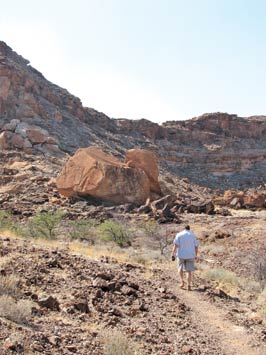
So the White Lady is a he; and not a Cretian, but a Bushman shaman, and most certainly drawn by the hand of a hunter-gatherer. The site with the White Lady (I know the title is wrong, but so is a Prince Albert) also has some beautiful images of zebras, stripes and all, and gemsbok; as well as other shaman images representing both sexes. In Bushman society, about half the men are shaman, as well as a third of the women, easily identified in rock art by their… how should I say this…? Kalahari swingers. A 45-minute walk to the site with a local guide is well worth it, considering the wealth of knowledge he offers about the site, its history and the local environment; plus, walking with someone who still relies on the land’s animal bounty is a unique experience.
The Brandberg itself is Namibia’s highest point, at about 2 574 m above sea-level. It is a granite massif that formed over the last 130 million years. In the massive mountain range there are over 1 000 rock shelters, and in the vicinity of 45 000 painted images. It is a marvel in itself, this desert refuge occupied for millennia by people surviving in what has been called a wasteland.
The Damaraland is rich in attractions. There is the renowned rock art site at Twyfelfontein, something you won’t find anywhere else in the world, with many thousands of Bushman engravings. For those less historically inclined, there is the Burnt Mountain, the organ pipes, the petrified forest and, of course, the spectacular desert elephants. Not far is Spitzkop, a marvel on its own. The entire area is worth exploring; and one of the coolest attractions, in more than one way, is Warmquelle spring – an awesome spot, a treacherous road and a brilliant site for a dip at the end of a long day of driving Namibia’s back roads.