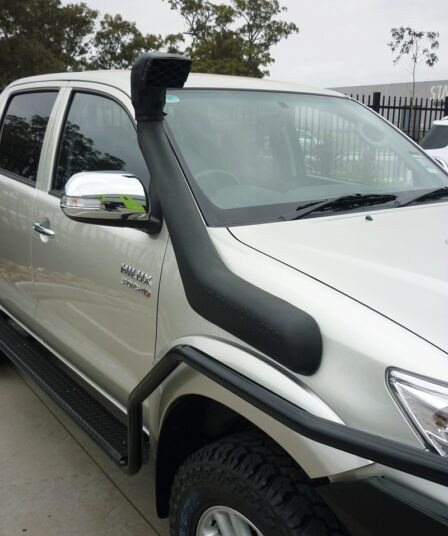
I’d always considered a vehicle snorkel to be one of those “fit once and forget about it” accessories. If it kept the engine breathing in muddy water and out of the dust hanging around the front wheel arch, then it had done its job. End of story.
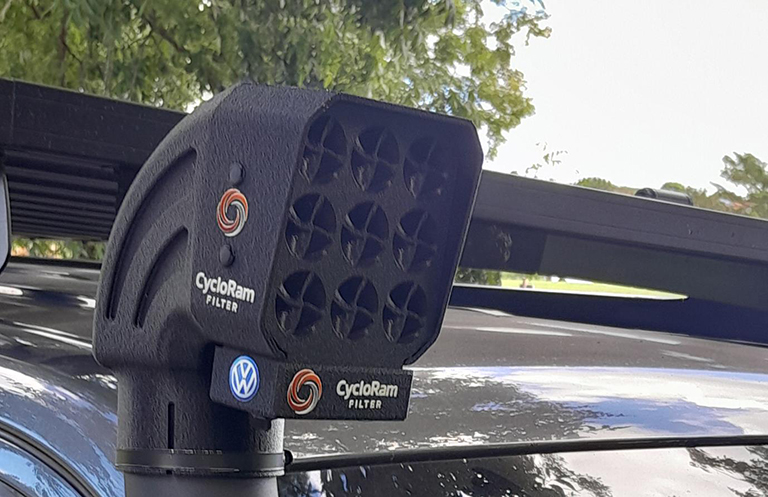
After spending time looking into the new CycloRam Cyclonic 4WD Snorkel Head, I’ve come to the conclusion that we’ve been focusing on the wrong part of the snorkel all along. While most of us obsess over the snorkel body itself—whether it’s Safari, ARB, Ironman or another reputable brand—the component doing the actual work is the snorkel head. And that’s exactly where CycloRam makes their biggest impact.
A Smarter Way to Protect Your Engine
Every overlander knows that dust is the silent killer.
It’s not the dramatic river crossing that usually destroys an engine. It’s the thousands of kilometres spent following another vehicle through the Kalahari, crossing Botswana’s salt pans, tackling Namibian gravel roads, or crawling along the corrugated back roads of the Karoo.
Let me tell you…Fine dust is relentless!
It slowly clogs your air filter, restricts airflow, increases fuel consumption and, if enough gets past the filter, accelerates engine wear, greatly! Most traditional snorkel heads simply raise the air intake higher above the dust cloud which is certainly better than the factory intake sitting behind the wheel arch. However, it matters not if you are the second, third or last vehicle in the convoy – traditional snorkels still allow everything that is kicked up – directly into your inner air filter box.
CycloRam approaches this very common problem differently.
Instead of merely relocating the intake, it starts cleaning the air before it even reaches your airbox.

Cyclone Technology That Actually Makes Sense
The clever part is the cyclonic airflow design.
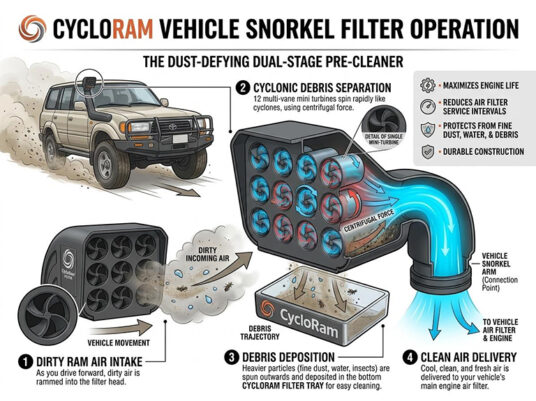
As air enters the snorkel head, it’s forced into a rapid spinning motion. Centrifugal force throws heavier dust particles, sand, insects and water droplets outwards where they’re separated from the main airflow instead of continuing down the snorkel funnel.
According to CycloRam, this system can remove up to 80% of dust and water at the very first intake point, dramatically reducing what reaches your engine’s air filter.
On paper that’s extremely impressive.
In the real world, it could mean the difference between cleaning your air filter every day on an outback expedition—or simply emptying the CycloRam’s removable dust collector and carrying on.
That’s a far easier job than pulling apart an airbox in the middle of nowhere.
The Feature I Like Most
What really caught my attention wasn’t actually the cyclone seperator itself.
It was the removable dust filter and collection chamber.
Anyone who’s driven in convoy knows just how quickly an air filter can become caked in red dust.
With a conventional snorkel, most of that dirt ends up inside your airbox.
With the CycloRam, much of it is trapped before it ever gets that far.
Imagine stopping for lunch after 300 km of dusty gravel roads.
Instead of removing your air filter and banging it against a tyre (we’ve all done it), you simply remove the CycloRam’s dust collection tray, empty it, clip it back on and continue driving.
For us, that’s practical engineering at its best.
Water Isn’t the Only Enemy
Many people still believe snorkels exist purely for river crossings.
Let me tell you, they don’t!
In reality, dust protection is arguably their biggest benefit. Drawing cleaner air from roof height helps reduce dust ingestion, while good snorkel designs also incorporate water-separation features for rain and splash protection.
CycloRam simply takes this one step further.
By actively separating most water droplets before it enters the snorkel body, it provides another layer of protection during heavy rain, unexpected splash crossings and those moments when your mate decides to hit the mud hole with a little too much enthusiasm.
No snorkel makes your vehicle a submarine, but every extra layer of protection is welcome when the consequences of hydrolock (when liquid enters an engine cylinder) can be catastrophic.
Less Maintenance Equals More Adventure
This is where CycloRam makes the biggest impact.
If you’ve ever completed a week-long overlanding trip, you’ll know that engine air filters become part of your daily maintenance routine.
Open bonnet.
Inspect filter.
Clean out dust residue.
Hope nothing has worked its way through to your engine.
Repeat tomorrow.
If the CycloRam genuinely removes anywhere close to its claimed dust percentage before the air even reaches the filter, your servicing intervals immediately become longer and your air filter remains far cleaner throughout the trip.
Cleaner filters also mean your engine breathes easier, maintaining performance and potentially improving fuel efficiency over long distances.
That’s something every overlander can appreciate when diesel stations are hundreds of kilometres apart.

How Does It Compare?
Traditional forward-facing snorkel heads have remained largely unchanged for decades.
They’re simple, effective and proven.
But simple isn’t always optimal.
Many overlanders turn their snorkel heads backwards in dusty conditions to reduce debris entering the intake. Sure, this method does help somewhat, although there are drawbacks. Others fit external snorkel socks or pre-filters that require regular cleaning and can restrict airflow if neglected. Community discussions consistently recognise cyclonic pre-cleaners as an effective solution for dusty environments because they separate contaminants before they reach the main filter.
CycloRam effectively combines those ideas into a single, purpose-built system.
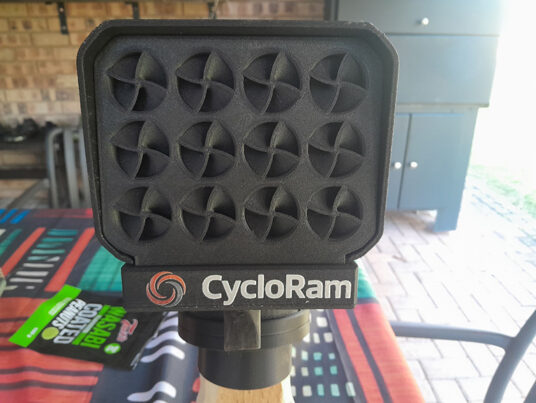
Rather than adding another accessory over your snorkel, the snorkel head itself becomes the pre-cleaner.
It’s a far more elegant and very cool solution.
Built for African Conditions
What impressed me most is that this isn’t a product designed solely around laboratory testing.
It appears to have been developed specifically with African overlanding conditions in mind.
Fine Kalahari sand.
Namib dust.
Botswana convoy travel.
Mozambique beach driving.
These are the conditions that expose the weaknesses of conventional snorkel heads.
When you’re travelling hundreds or even thousands of kilometres from the nearest workshop, reducing engine maintenance isn’t simply convenient—it’s peace of mind.

Final Verdict
I’ll admit it. After looking into the CycloRam, I genuinely think it’s one of those rare products that solves a problem many of us simply accepted as “normal.”
If it consistently removes anything close to the claimed 80% of dust and water before the air reaches your air filter, then it’s doing something that conventional snorkel heads simply don’t.
Cleaner air.
Longer air filter life.
Reduced engine wear.
Less maintenance.
Greater peace of mind when you’re hundreds of kilometres from civilisation and flatbed recovery trucks
Plus, its looks awesome too!
For serious overlanders, tour operators, farmers, game rangers and anyone who spends more time on gravel than tar, those aren’t gimmicks—they’re tangible advantages.
Would I replace a perfectly good snorkel just for the CycloRam?
Probably not.
Would I replace the snorkel head?
Without hesitation!
Sometimes the smallest upgrades make the biggest difference, and the CycloRam might just be one of the smartest insurance policies you can fit to your 4×4 before pointing its nose towards Africa’s dusty horizon.
For more information on this newly featured product, including online ordering, delivery, fitment instructions, pricing or size availability, please use the enquiry form below to contact the manufacturer.
Alternatively, you can send them a Whatsapp on 082 775 7661
Business enquiries are welcome and this product is available for nationwide delivery in South Africa.